let's not become a museum
Sent to me by a friend and co-leader in our church. Love it. What do you think?
Sent to me by a friend and co-leader in our church. Love it. What do you think?
On this Monday after Sunday, I'm sitting here reading Why We Love the Church by Kevin DeYoung and Ted Kluck and I'm literally laughing out loud. . . . all by myself. Kluck, the non-pastor lay guy, especially, cracks me up with his brutal honesty and touch of sarcasm. . .
Just had to share. . . . .
In his book, "Wide Open Spaces, author Jim Palmer explains that he has left the church in favor of a Wednesday night meeting with a friend at Starbucks. He talks of spiritual discussions on a boat with a best friend. He says of these meetings, "If one of us starts into those religious modes of thinking, or drones on in God-talk that has little correlation to our daily reality, we quickly rein things back in.
And later, "There's no person or set of persons you can point to as the ones in charge of or responsible for what happens. All of us believe that we have an equal 'calling' to know God and make him known amid ordinary life and people. Everyone is a leader and a follower, everyone is a teacher and student."
Palmer's construct of "neo-church" certainly sounds exciting, what with regular trips to Starbucks, Panera, and excursions out on his friend's boat. But being involved in these sorts of organic house churches--or for that matter even real church--for any period of time, will reveal that not everyone is a "leader" or "teacher."
Never am I more of a fan of the traditional pastor/flock relationship at our church than when the church has what they call an "unstructured service." The unstructured service is a holdover from the church's freewheeling 1970s days and involves, as you might expect, an open mic where congregants share a story, pray, or suggest a song. On paper this seems like a great idea. What kind of coldhearted meanie wouldn't be a fan of people sharing encouragement of prayer requests from their heart?
During unstructured services I usually sit and stare at my bulletin, which I've folded into a tiny pile about the size of a square inch. This is nervous energy. Nervous because of the reality that many people weren't gifted with the ability to stand in front of a group and say something that is God-centered, relevant, and brief. Out of the three, I would take brief. Maybe you've been to services like this. You often hear the sweet older lady who talks for no less than seventeen minutes about her kidney ailment. There is the well-meaning, attractive guy who shares about how all the girls in our church's college group want to get physical with him, and how difficult this is. And, if you're lucky, you might get a bad poem, because, lets' face it, almost all poems are bad. I'm left with the idea that if this is what revolutionary house church would look like on a week-to-week basis, then I'm definitely out.
To be fair, there are always good things that come out of the unstructured service, but I'm usually left feeling really thankful for our pastor and his forty-five minute expositional sermons. Though its much sexier to appear to have come up with something off the top of one's head, I'm glad he spends twenty hours each week reading, praying, and preparing linear sermons.
In Sunday's message, we talked some more about "covenant community" and how we move toward it here at GraceSLO.
What is a "covenant"? In its broadest Biblical sense, a "covenant" is a committed and intimate relationship. Jesus makes possible a new "covenant" or committed intimate relationship with God by means of His shed blood. At the same time He calls us into a new "covenant community" called the church.
By "covenant community" I mean the kind of a committed, intimate, relational community which is implied in Acts 2:42, Romans 12:9-13 and numerous other passages which speak of the church's life together.
How do we move toward the kind of community God desires and the Bible describes for God's people in the church?
On Sunday, I highlighted two key commitments that our elders and pastors believe can move us forward in the days ahead. . . .
- Do you and the leadership anticipate keeping the growth group model currently being utilized? Are those groups going to continue being sermon based?
We are committed to a "main stream" of Growth Groups that will be sermon-based, but we've also acknowledged the need for a few short term "tributaries" (working on a better term!) off the "mean stream". These "tributaries" will address felt need topics like parenting and marriage stuff. These groups and their leaders will be approved and the aim will be to get folks back into the "main stream" of the sermon based model as soon as possible. Our focus will continue to be sermon-based groups for a whole host of reasons including quality control, unity, growth in the same direction, leader equipping and training, manageability, maximizing the church's limited resources, and scalability.- Do you anticipate groups which will be gender specific, as well as gender specific groups being led by women or men?
We're open to gender specific groups. We have had some in college for the last three years. But we also believe it's valuable and preferable, whenever possible, to get couples in groups together. Our experience is that couples just don't know how to talk about spiritual things very well and we believe a healthy, vibrant Growth Group can help couples grow in this area. Similarly, we believe couples together in Growth Groups is family-supporting, rather than segmenting the family throughout the week. We're trying to be careful to not undermine the family and its precious time together.
We're open to Growth Groups organized around ages and stages of people's lives. (singles, married without kids, divorced, etc) We're fine with gender specific groups being led by leaders of the same gender. We're open to husbands and wives co-leading mixed-gender groups.
- With the shift of focus at the church, who will be giving over site to this ministry?
For now, Pastor Steve will continue to give over site to this ministry, though Ken, Steve, and I are working on a lot of this stuff together.
- I know you just touched on membership and will be flushing that out more in the next few weeks, what will that look like for those wanting to serve at the church? Will membership be required to do so?
We will tie serving to membership for most serving positions/places, but not all. I don't see membership being required for "entry level" and occasional serving positions like greeting, refreshments or Fall Kick-Off helpers, I'm open when it comes to POW Small Group leaders. Membership will be required for Growth Group Leaders and those who teach Sunday School. Our goal will to encourage all to move toward membership as a way of committing to our covenant community. The staff and elders have got a long way to go in terms of fleshing all this out, but these are my thoughts today. We see membership as a way of building a relational community, being accountable to one another, caring for one another, and shepherding the flock. Those who have a conscience issue with church membership we would work with individually. Those who don't want to become members, will be welcome here and not second class citizens, but limited in the places they can serve.
We're really aware the church membership will an "uphill swim", in our culture which is increasingly individualistic and non-committal, but our moving forward is driven by a desire to better "be the church" and to better "shepherd the flock." We believe the Lord calls us to commit to one another, even in, or especially in, an age of non-commitment.
- Are you anticipating a series of classes to instruct in this area?
We do anticipate membership training classes. Pastor Ken has already begun teaching regular "Getting to Know Grace" classes, which we see morphing into Membership Classes. I expect for the great majority of the congregation, we will devise an initial way for them to become members.
- Will growth group participation be a requirement of church membership?
Again, we've got to flesh this out, but I imagine something like this being a part of a membership covenant. . . . .
"Since the Christian life is not a solo or individual journey, I commit to regularly being involved with others here at GraceSLO in a Growth Group (our preference) or some other type of small group (men's, women's or other)."
I would define regular as at least one quarter a year.
Some of you will recall the blog storm surrounding the sharing of my views about politics and the church around Christmas time. I sure haven't forgotten the strong and varied reactions.
(I'll let you go back and find those posts, if you're so inclined!)
I shared, then, that my views were my own and didn't necessarily represent the views of all the elders or the official position of the elder board as whole. (Some of you didn't like that fact that I was sharing my "personal views" on this blog.) I also shared that the elders' discussions of these matters were ongoing.
Well. . . they're still ongoing. This is an issue we have talked much about over the last 4 months as this election year envelopes us. Just last Thursday we took the time to listen to a great seminar from the last month's Shepherd's Conference entitled "Politically Incorrect?" given by Phil Johnson.
Here were four Biblical insights that Johnson compellingly argued should guide our practice in these matters. They resonated with us all . . .
Today is Veteran's Day. Leading up to and following this weekend, three similar requests/inquiries have come my way. I have been interacting with several folks via email and have promised that I would commit my thoughts and share my views here at Life Together, so that others might understand my convictions in this area.
Here are the 3 requests/inquiries:
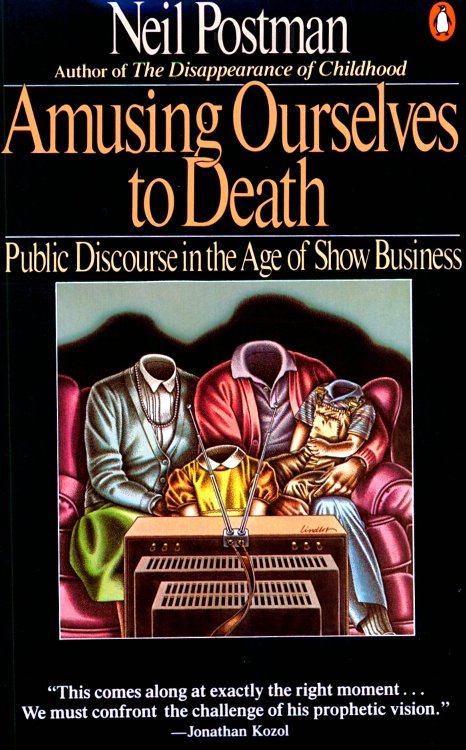
One of the most influential books I read in seminary was "Amusing Ourselves to Death" by Neil Postman. Have you ever read it? Please do.
Pastor Al again sent me a great article from Christianity Today entitled "Amusing Ourselves on Sunday." The article talks about the dangers and pressures of entertainment culture on the church. A good reminder and relevant to our recent discussion of media uses.
Here's a great quote:
"When a population becomes distracted by trivia, when cultural life is redefined as a perpetual round of entertainments, when serious public conversation becomes a form of baby-talk, when, in short, a people become an audience and their public business a comedy show, then a nation finds itself at risk."
In Sunday's message entitled "A People of the Book" from 1 Peter 1:23-2:3, I talked about the centrality of the Word of God in the life of the People of God.
(If you missed the message, I think you'll find it helpful and explanatory. In it, I explain our worship service, the historical symbolism of the pulpit and the place of the Bible in the process of salvation . . . among other things.
I got this great email from Steve Potratz. He gave me permission to post it in our shared hope that it would stir up some dialogue. So let it roll . . .
Tim,
Many times Jesus would say: “You have heard that it was said… but I tell you…” One of Jesus greatest teaching challenges was helping people unlearn.
Over the years our church has taught people to bring their bibles to church. Deane Keller consistently encouraged people to mark their bibles. One of his trademarked phrases was “circle the word…” I remember him joking about it when he preached at the anniversary.
I so appreciated your message Sunday and your emphasis on the Word. You were right on. I appreciate too your explanation of the service structure. In that explanation you invited comments on the Keynote slides. I would like to add my two cents: We visit a lot of church throughout the country. When pastors put the scripture in their presentation we consistently observe very few bibles being carried by the people. I know you have purposely not included the main scripture text. However, by including all of the reference text (I know you do it to save time – and I honor that) I have noticed fewer people using or bringing their bibles to Grace. Two weeks ago Sunday only 6 people in 20 sitting around me had a bible open during the message. I would like to suggest you not display any scripture in your Keynote slides. Encourage people to use their bibles by turning to the text – even if it’s just for one verse. I would also like to encourage you to encourage the people to mark their bibles. The more people use their bibles the more they will use their bibles.
I use my computer for my morning devotions. I use my handheld many times in church. I have noticed that this is detrimental to my retention of scripture – I need to carry and mark up a physical bible and do except on choir Sundays.
While I’m writing, I would like to suggest one other thing: I like your emphasis on the pulpit and the delivery of the Word. How about keeping the pulpit for ONLY this purpose? Have the scripture read from the pulpit and delivered from there. Maybe the pastoral prayer too – but keep all other uses to a side or other locations. In other words, I don’t know why we read scripture from a side mike?
Just some thoughts – I would love to see people learn to use their bibles more and understand the use of the tools built into their bibles. It is amazing to me to see how few people understand how to use the reference system in their bible or even why it’s there. As you said Sunday, the bible literacy is very low.
No need to respond. I really appreciate your leadership, your teaching and your love for the people. To God be the Glory.
Standing firm,
Steve
Here is part of an email I received this week from a recent college grad. The reason it was so encouraging to me is not because he enjoyed Sunday's message, but because he's "getting" the church. . . . .
Yesterday as I was driving home after dinner with some friends, I thought a lot about the passage that you taught about in the morning. After rethinking through all of the ideas you expressed about the idea of “What in the world is the Church?”, I felt inclined to email you. I think I got the idea to email you for a couple of reasons. First, I wanted to let you know how much I agreed with the sermon, specifically about the relationship between college student’s involvement with on campus ministries and the local church, and also to offer a little encouragement, if possible.I'm excited about where our Fall series, "What in the World is the Church?" is going to take us . . . Come along!
I started attending Grace this February, and have come to fall in love with it, joining a growth group, going to Mexico with the high schoolers, playing basketball on Thursday nights, and being apart of the church family in other ways. I graduated from Cal Poly in June of 2006 and never really had a church home throughout college. I was heavily involved with Campus Crusade for Christ all five years and although I owe a lot of my spiritual growth and maturity to that movement, I have come to realize how much I missed out by not getting involved with a local church those five years. I found myself looking around during yesterday’s service and couldn’t have agreed more with your urge for college students to get involved with the church. We all do need each other, young and old, men and women, mature and still learning, rich and poor, etc., and I can tell that Grace Church is on the right track to be a church described in the Bible. The church isn’t about what I can get out of it, but how we can grow together to glorify and worship the Lord. Grace Church has become a place where I experience peace, belonging, the Story, and His presence.

www.flickr.com
|